 |
||||
 |
||||
 |
Juan Nepomuceno Almonte 1803-1869
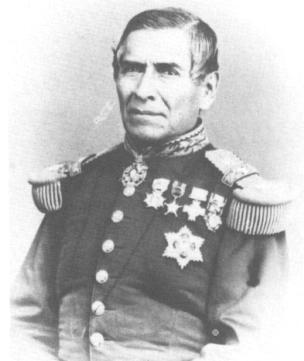 Almonte
was a natural son of mestizo parish priest, guerilla leader and revolutionary
for separation of Mexico from Spain, José María Morelos y Pavon and an Indian
woman Brigida Almonte, born in Necupétaro, Michoacán on 15 May 1803. Historian
Foote conjectured that the origin of the surname Almonte was as follows:
Almonte
was a natural son of mestizo parish priest, guerilla leader and revolutionary
for separation of Mexico from Spain, José María Morelos y Pavon and an Indian
woman Brigida Almonte, born in Necupétaro, Michoacán on 15 May 1803. Historian
Foote conjectured that the origin of the surname Almonte was as follows:
"Morelos was at the head of his troops one day, when an infant, whose birth was thus unceremoniously made known to him, was brought into his sight by the mother. 'Almonte, Almonte,' ---to the mountain with the brat' and Almonte was thenceforth his name."
Morelos is said to have sent young Almonte to be educated in America with Republican emissaries Don Manuel de Herrera and Pedro Ellis Bean in July along with 30,000 pesos for purchase of support for the revolution to the United States. Father Morelos was captured, defrocked and shot as a traitor in December 1815 after which Almonte's education was ended prematurely and he became a clerk in a hardware store in New Orleans. Almonte allied with Vicente Guerrero at the beginning of the Mexican revolution and was in Nacogdoches when Mexican independence was won in 1821 at which time he returned to Mexico with Bernardo Gutierrez who was appointed Governor of Tamaulipas. He was on the staff of José Félix Trespalacios in Texas. In 1824 he was in the Mexican legation to Britain and in 1824 credited with being instrumental in finalizing independent Mexico's first commercial agreement with England or any foreign power. In 1830 Congressman Almonte was censured and forced into hiding. As an editor of a newspaper called El Atleta, he criticized President Anastasio Bustamante for permitting foreign intervention in Mexico. He allied with Santa Anna and in 1834 he was sent by Santa Anna to Texas to prepare a Statistical Report on the status of the territory, and most likely to assess the colonists loyalty to Mexico and the feelings toward independence. Most of the three months he was with Colonel Bean, the old friend of his father Jose Morelos. Almonte filed a favorable report concerning the Texas colonists, their economic development and future contribution to the Mexican Republic. It was believed to be influenced by Col. Bean who Almonte complimented in a later letter by stating "only his [Bean's] good offices and prestige.......conserved order in this part of our territory."Although brief and relatively superficial, the report is one of the few insights into the economics and demographics of the colonies as well as an honest non-biased technical assessment from the Mexican government at that juncture in Texas and Mexican history. Almonte stayed allied with Santa Anna during his seizure of power under the Republican banner and his abrogation of the Constitution of 1824. In 1836, Almonte became Santa Anna's secretary and confidential adviser. He was with Santa Anna at the Alamo in Feb-Mar 1836 and participated in the assault.
Almonte surrendered with the Mexican army at San Jacinto and an account by General Rusk was as follows:
"At the close of the fight, and just after sundown, Colonel Almonte came out of the woods with about 250 men. There were at that place not exceeding ten or fifteen Americans; and none of them could speak the Mexican language well. The prisoners were asked if they could speak English. Almonte answered in Spanish that they could not. They were then told in Spanish to form two and two deep and march with us to camp. They formed and commenced marching accordingly. Our few men were distributed around them as a guard. Most of us were very much fatigued, and such was the condition of the Mexicans, also. As we proceeded in this way, one of our men, who was so tired he could hardly walk, being incommoded by a Mexican who had dropped out of the line cursed and threatened him in a very rough manner in English. This threat was immediately repeated to the Mexican in Spanish. I concluded that he, at least, must understand English very well, and that it was probably Almonte whom I saw before me. I therefore observed to him, 'You must be Colonel Almonte'. He replied in English, 'You speak well.' I then rode up to him and gave him my hand, saying to him, 'It affords me great pleasure to see you, Colonel.' With great presence of mind and his customary politeness he responded 'The pleasure is reciprocated.'" Almonte remained by Santa Anna's side during his imprisonment acting as both interpreter and negotiator. He accompanied the dictator to the US and returned with him to Mexico upon his release.
Author Thrall pointed out that in the estimation of Almonte, defeat was not an extraordinary event in the life of a soldier of fortune. He conversed freely and without reserve with those Texans whose acquaintance he had formed two years before. There is no doubt but that his philosophic and cheerful temper had its effect upon the Texans, and reconciled them to the measures of the President and Cabinet in sparing the lives of Santa Anna and his officers.
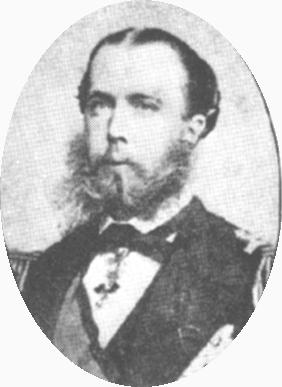 In
1840 Almonte became Minister of War under Anastacio
Bustamante, and was instrumental in suppressing a rebellion
inaugurated by his former colleague Gen. Jose Urrea. After Bustemente's
overthrow, Almonte for a while supported himself by lecturing. After Santa Anna
returned to power, Almonte was appointed Minister to the United States. When
Congress passed the bill for the annexation of Texas, Almonte denounced it and
demanded his passport. He stated "that America had committed the most
unjust act recorded in history." In 1846 he was Minister to Great
Britain; 1853 to the United States; 1856 again to Great Britain. In Europe and
in contrast to his earlier nationalistic views, Almonte promoted European
intervention in Mexico and return to monarchy and returned with French troops in
1862. He was appointed "supreme chief" of Mexico by the French and
president of the French Executive Council that brought in emperor Maximilian (photo
left). Almonte died 21 Mar 1869 in Paris while envoy to France appointed by
the emperor.
In
1840 Almonte became Minister of War under Anastacio
Bustamante, and was instrumental in suppressing a rebellion
inaugurated by his former colleague Gen. Jose Urrea. After Bustemente's
overthrow, Almonte for a while supported himself by lecturing. After Santa Anna
returned to power, Almonte was appointed Minister to the United States. When
Congress passed the bill for the annexation of Texas, Almonte denounced it and
demanded his passport. He stated "that America had committed the most
unjust act recorded in history." In 1846 he was Minister to Great
Britain; 1853 to the United States; 1856 again to Great Britain. In Europe and
in contrast to his earlier nationalistic views, Almonte promoted European
intervention in Mexico and return to monarchy and returned with French troops in
1862. He was appointed "supreme chief" of Mexico by the French and
president of the French Executive Council that brought in emperor Maximilian (photo
left). Almonte died 21 Mar 1869 in Paris while envoy to France appointed by
the emperor.
