 |
||||
 |
||||
 |
ESTEVANICO (?-1539).
Estevanico, also known as
Estevan, Esteban, Estebanico, Black Stephen, and Stephen the Moor, was a native
of Azamor, on the Atlantic shore of Morocco. In Spain before 1527 he became the
personal slave of Andrés Dorantes de Carranza. Though Estevanico is usually
referred to as a Negro or African black, a Spaniard, Diego de Guzmán, who saw
him in Sinaloa in 1536, described him as "brown." Estevanico
accompanied his master as a member of the Narváez expedition, which landed in
mid-April 1528 near what is now called Tampa Bay. Narváez, after a futile
attempt at marching along the Gulf Coast, elected to slaughter the horses and to
build five makeshift barges. The boat containing Estevanico was placed under the
joint command of Dorantes and Alonso Castillo Maldonado. After a month at sea,
the craft was wrecked on or near western Galveston Island. On foot Estevanico,
Dorantes, and Castillo reached Matagorda Bay, the only survivors to do so. Their
continued safety among hostile coastal Indians hinged on the success of faith
healing, first introduced to them by Castillo Maldonado. After six years of
precarious existence, a fourth survivor, Álvar
Núñez Cabeza de Vaca, joined them. Subsequently, the castaways escaped to
the interior of Texas.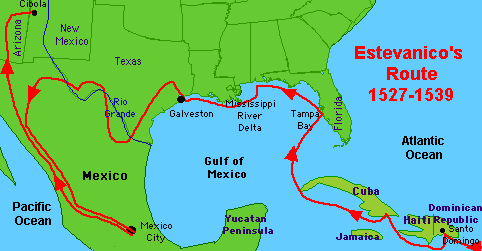
Estevanico was the first African-born slave to traverse Texas. In the company of his master, he traveled a west-by-northwest route from the site of San Antonio to that of Pecos. In March 1536 the four survivors were reunited with their countrymen north of Culiacán in Nueva Galicia, where Dorantes sold Estevanico to Viceroy Antonio de Mendoza. The viceroy assigned the slave to a Franciscan, Fray Marcos de Niza. Niza had been ordered to Nueva Galicia, where he was to leave Culiacán in early March of 1539. On March 21, 1539, he and Estevanico arrived at the Río Mayo in what is now Sonora. There Estevanico, restless over the slow progress of the friar and his support party, was sent ahead as an advance scout. Separated by several days' travel from Niza, Esteban approached Cíbola, thought today to be the pueblo of Hawikuh, and announced his intentions to make peace and heal the sick. He told the villagers that he had been sent by white men who would soon arrive and instruct them in divine matters. The village elders, suspicious of his claims that he came from a land of white men because he was dark, and resentful of his demands for turquoise and women, killed him when he attempted to enter the village. Hawikuh, the southernmost of the seven pueblos known as the Seven Cities of Cíbola, was located fifteen miles southwest of the site of present Zuni, New Mexico.
BIBLIOGRAPHY: Carolyn Arrington, Black Explorer in Spanish Texas: Estevanico (Austin: Eakin Press, 1986). Stephen Clissold, The Seven Cities of Cíbola (London: Eyre and Spottiswood, 1961). Cyclone Covey, trans. and ed., Cabeza de Vaca's Adventures in the Unknown Interior of America (New York: Collier, 1961; rpt., Albuquerque: University of New Mexico Press, 1983). Harbert Davenport, ed., "`The Expedition of Pánfilo de Narváez,' by Gonzalo Fernández Oviedo y Valdez," Southwestern Historical Quarterly 27-28 (October 1923-October 1924).
Donald E. Chipman
