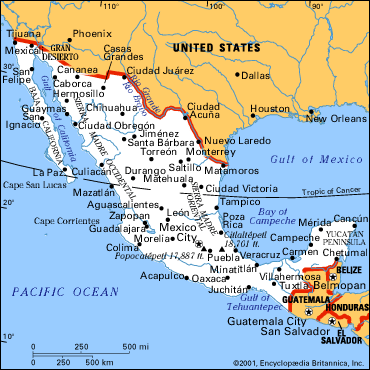
 Officially United Mexican States, republic (1995 est. pop. 93,986,000), 761,600
sq mi (1,972,544 sq km), S North America; bordered by the U.S. (N), the Gulf of
Mexico and the Caribbean Sea (E), Belize and Guatemala (SE), and the Pacific
Ocean (W). Principal cities include Mexico
City (the capital),
Guadalajara, and
Monterrey. The country is predominantly mountainous, and less than 15% of
the land is considered arable. There are lowlands in the southeast and along the coasts, but the heart of the country is the extensive Mexican plateau, with
elevations generally above 4,000 ft (1,220 m). Fringed by the ranges of the Sierra
Madre, the plateau (except for the arid north) is a region of broad, shallow
lakes where more than half of the country's population is concentrated. To the
south is a chain of extinct volcanoes, including Popocatepetl, Ixtacihuatl, and
Citlaltepetl, which at 18,406 ft (5,610 m) is Mexico's highest point. Since
World War II Mexico has had considerable economic growth. Agriculture engages
about a quarter of the active workforce and is slowly being modernized. Major
irrigation projects have increased yields. Cotton, coffee, sugar, and tomatoes
are the major export crops, and much corn, wheat, beans, and citrus fruits are
grown. Livestock raising and fishing are also significant. Mexico has
considerable mineral resources, including vast petroleum reserves and zinc,
sulfur, silver, antimony, copper, and manganese. Industries, usually in or near
the larger cities, produce iron and steel, motor vehicles, engines, processed
foods, refined petroleum and petrochemicals, chemical fertilizers, and other
products. Assembly factories (maquiladoras)
along the U.S. border are a major source of foreign income. Tourism is also
economically important. The population has grown rapidly in the 20th cent., more
than quadrupling from 1940 to 1990. However, declining fertility rates are
slowing population growth. The great majority of the people are of mixed Spanish
and indigenous descent, but a sizable minority are of purely indigenous descent.
The official language is Spanish, but some Mexicans still speak only indigenous
tongues. About 90% of the people are Roman Catholic.
Officially United Mexican States, republic (1995 est. pop. 93,986,000), 761,600
sq mi (1,972,544 sq km), S North America; bordered by the U.S. (N), the Gulf of
Mexico and the Caribbean Sea (E), Belize and Guatemala (SE), and the Pacific
Ocean (W). Principal cities include Mexico
City (the capital),
Guadalajara, and
Monterrey. The country is predominantly mountainous, and less than 15% of
the land is considered arable. There are lowlands in the southeast and along the coasts, but the heart of the country is the extensive Mexican plateau, with
elevations generally above 4,000 ft (1,220 m). Fringed by the ranges of the Sierra
Madre, the plateau (except for the arid north) is a region of broad, shallow
lakes where more than half of the country's population is concentrated. To the
south is a chain of extinct volcanoes, including Popocatepetl, Ixtacihuatl, and
Citlaltepetl, which at 18,406 ft (5,610 m) is Mexico's highest point. Since
World War II Mexico has had considerable economic growth. Agriculture engages
about a quarter of the active workforce and is slowly being modernized. Major
irrigation projects have increased yields. Cotton, coffee, sugar, and tomatoes
are the major export crops, and much corn, wheat, beans, and citrus fruits are
grown. Livestock raising and fishing are also significant. Mexico has
considerable mineral resources, including vast petroleum reserves and zinc,
sulfur, silver, antimony, copper, and manganese. Industries, usually in or near
the larger cities, produce iron and steel, motor vehicles, engines, processed
foods, refined petroleum and petrochemicals, chemical fertilizers, and other
products. Assembly factories (maquiladoras)
along the U.S. border are a major source of foreign income. Tourism is also
economically important. The population has grown rapidly in the 20th cent., more
than quadrupling from 1940 to 1990. However, declining fertility rates are
slowing population growth. The great majority of the people are of mixed Spanish
and indigenous descent, but a sizable minority are of purely indigenous descent.
The official language is Spanish, but some Mexicans still speak only indigenous
tongues. About 90% of the people are Roman Catholic.
History
Before the arrival of the Spanish in the early 16th cent., great indigenous civilizations (the Aztec, Maya, Toltec, Mixtec, Zapotec, and Olmec) flourished in Mexico.
Arriving in 1519, Hernan Cortes overthrew the Aztec empire (1521) and captured its ruler, Montezuma. The territory became the viceroyalty of New Spain in 1535. Spanish conquerors exploited the mineral wealth of the land, using as laborers the native population and a growing mestizo class; at the same time they extended Spanish rule to the remainder of Mexico and to what is now the SW U.S.
A rebellion led (1810-15) by Miguel Hidalgo y Costilla failed, but in 1821 Spain accepted Mexican independence, and an empire, headed by Augustin de Iturbide, was established in 1822. In 1823 army officers overthrew the empire and established a federal republic. The early years were marked by turmoil and corruption.
Texas broke free of Mexican rule in 1836, and in the ensuing Mexican War (1846-48) with the U.S., Mexico lost much territory. Internally, the republic was torn by strife among contending political leaders, and in 1855 a democratic reform movement, led by Benito Juarez, overthrew the dictatorship of Antonio Lopez de Santa Anna and drafted a liberal constitution.
Civil war followed, and in 1864 Napoleon III of France, who had colonial ambitions, established another ill-starred Mexican empire, under the Hapsburg prince Diaz, who ruled Mexico for most of the 35 years after 1876. Diaz promoted economic growth and provided a degree of stability, but his encouragement of the concentration of wealth in the hands of a few spawned a new generation of revolutionaries.
Among these were Emiliano Zapata, Francisco Pancho Villa (whose raid into the U.S. in 1916 resulted in a brief retaliatory U.S. invasion of Mexico), and Francisco I. Madero, who toppled Diaz in 1911 but was himself overthrown and murdered in 1913.
A foundation for reform was laid by Venustiano Carranza's constitution of 1917. In 1929 Plutarco Elias Calles founded the National Revolutionary party (renamed the Institutional Revolutionary party, or PRI, in 1946), which became the dominant political party in 20th-century Mexico. During the presidency of Lazaro Cardenas (1934-40), land was redistributed, illiteracy reduced, power projects initiated, and some industries nationalized. Cardenas's successors have tended to stress industrial development, which has benefited the middle and upper classes.
In 1982, following a drop in world oil prices, the faltering economy caused the government to devalue the peso and nationalize the banks; the country's enormous foreign debt hampered economic growth. By the early 1990s, however, debt relief, diversification, foreign investment, and privatization of many industries long owned by the Mexican government had begun to produce an economic upturn.
In 1988 Carlos Salinas de Gortari was elected president amid charges of widespread fraud. Salinas opened Mexico to foreign investment, signing the North American Free Trade Agreement with the U.S. and Canada. There was a general improvement in the economy, but a Mayan-based uprising (1994-96) in the southern state of Chiapas highlighted the poverty in which many Mexicans still live. Ernesto Zedillo Ponce de Leon, the PRI candidate, succeeded Salinas in 1994; his election was regarded by observers as generally fair. Shortly after Zedillo took office, the peso's value began to slide; devaluation and the government's stabilization program sent the economy into recession in 1995. In 1996 the PRI and the three main opposition parties signed an agreement designed to democratize the electoral process and end fraudulent practices used by the PRI to dominate Mexican politics. Following the 1997 legislative elections, a four-party opposition coalition took control of the lower house of congress.
In 2000 the PRI candidate, Francisco Labastida Ochoa, lost to the National Action party candidate, Vicente Fox Quesada, a historic opposition victory that ended more than 70 years of PRI rule. See Presidents of Mexico since the Constitution of 1917 for a table of Mexican presidents since 1917.
|
History in Brief |
| B.C. | 1200-1000 | Olmec |
| 1800-900 | Early Preclassic Maya | |
| 900-300 | Middle Preclassic Maya | |
| 300 B.C. - A.D. 250 | Late Preclassic Maya | |
| A.D. | 250-600 | Early Classic Maya |
| 600-900 | Late Classic Maya | |
| 900-1500 | Post Classic Maya | |
| 1521-1821 | Colonial period | |
| 1821- today | Independent Mexico |
Presidents of Mexico since the Constitution of 1917
| Venustiano Carranza | 1917-20 | |
| Adolfo de la Huerta | 1920 Alvaro Obregon | 1920-24 |
| Plutarco Elias Calles | 1924-28 | |
| Emilio Portes Gil | 1928-30 | |
| Pascual Ortiz Rubio | 1930-32 | |
| Abelardo L. Rodriguez | 1932-34 | |
| Lazaro Cardenas | 1934-40 | |
| Manuel Avila Camacho | 1940-46 | |
| Miguel Aleman | 1946-52 | |
| Adolfo Ruiz Cortines | 1952-58 | |
| Adolfo Lopez Mateos | 1958-64 | |
| Gustavo Diaz Ordaz | 1964-70 | |
| Luis Echevarria Alvarez | 1970-76 | |
| Jose Lopez Portillo | 1976-82 | |
| Miguel de la Madrid Hurtado | 1982-88 | |
| Carlos Salinas de Gortari | 1988-94 | |
| Ernesto Zedillo Ponce de Leon | 1994-2000 | |
| Vicente Fox Quesada | 2000- |
